Beauty shopping in the UK today means reading words from all over the world. A single shelf can carry Korean essences, French eaux, Indian oils, and Japanese lotions — each with its own vocabulary, traditions, and claims. Global beauty terminology can feel like a second language, but it does not have to be confusing. In this guide to global beauty terminology, we decode the international beauty terms UK shoppers meet most often, and explain how concepts travel between cultures while keeping their original meaning.
Beauty vocabulary travels because beauty itself travels. Products, routines, and ingredients move between countries through trade, travel, and social media, and their words travel with them. Understanding those words helps you shop with confidence, compare products fairly, and avoid paying a premium for a familiar idea dressed in unfamiliar language.
Why Beauty Terms Travel
Beauty terms travel for the same reason food terms do: a product from another culture brings its own language, and that language often stays because it carries meaning that a translation would lose. Essence, for example, describes a specific step in Korean skincare — a light, hydrating liquid used after cleansing — and calling it a serum or a toner would not quite capture it. Similarly, a French term may signal a particular formulation tradition, while an Indian term may point to an ingredient with a long history of use.
That is why a good beauty vocabulary guide does not just translate words — it explains concepts. Knowing what a term means in its original context helps you judge whether a product using that term actually delivers the concept, or is simply borrowing the word for marketing.
For the foundations of reading beauty language, see our guide to beauty literacy, which teaches how to read labels, claims, and ingredient lists with confidence.
Korean Beauty Terms UK Shoppers Meet Most
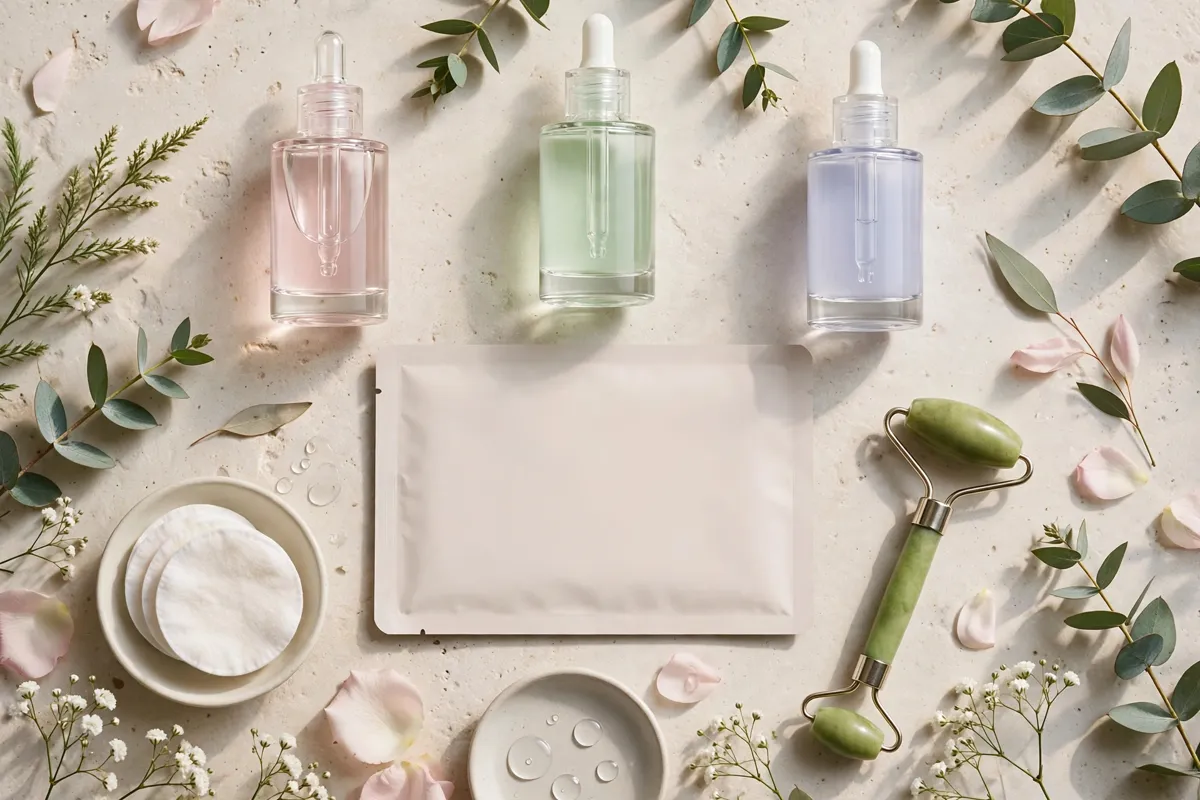
Korean beauty terms are the most common international vocabulary on UK shelves. Essence is a lightweight hydrating step. Ampoule is a more concentrated treatment, similar to a serum but often more targeted. Cushion refers to a compact format for foundation or skincare, designed for portable, buildable application. Sleeping pack is an overnight mask left on while you sleep. Cica, short for centella asiatica, is an ingredient associated with soothing skin, and glass skin describes a finish — clear, luminous, and hydrated-looking — rather than a product itself.
Our guide to K-beauty vocabulary decodes these terms in full, with examples of how they appear on UK products. If Korean terms are the ones confusing you most, that guide is the place to start.
Japanese, French, and Indian Beauty Terms
Japanese beauty terms often emphasise layering and gentle hydration. Lotion in Japanese skincare usually means a watery hydrating liquid, not a thick cream as in the UK, and emulsion is a light moisturising step. Those differences matter: using a Japanese lotion as if it were a UK body lotion will give a different result than expected, simply because the word means something different.
French beauty terminology often centres on pharmacy and dermatological traditions: micellar water for gentle cleansing, thermal water for soothing, and a general emphasis on minimal, well-tolerated formulas. Indian beauty terminology brings ingredients with long traditional use — turmeric, neem, and various oils — and concepts around holistic skin health that go beyond a single product’s function.
Across all these traditions, the same rule applies: a term’s original meaning is the best guide to what a product should do. When a product uses a term loosely, or in a way that contradicts its original meaning, that is useful information about the product, not just about the word.
International Skincare Trends and Beauty Culture
Global skincare vocabulary also reflects global skincare trends. When a concept becomes popular — glass skin, skinimalism, barrier care — its vocabulary spreads quickly, sometimes faster than understanding of the concept itself. That speed creates confusion, but it also creates opportunity: shoppers who understand the terms can separate genuine trends from marketing noise.
Beauty culture terminology also carries values. Some cultures emphasise prevention and daily care, others emphasise treatment and correction, and still others emphasise natural ingredients or scientific formulation. Recognising those values helps you understand why products from different countries feel different, and why a routine that works in one culture may need adapting in another.
How to Use Global Beauty Terms When Shopping
When you meet an unfamiliar beauty term, start with the product itself: what does it claim to do, what are its main ingredients, and how is it meant to be used? Then check the term’s original meaning, whether in a guide like this one or from a reliable source. If the product’s claims match the term’s meaning, and the ingredients support it, the term is being used honestly. If they do not match, treat the term as marketing and judge the product on its own merits.
Be particularly careful with terms that imply medical or scientific authority without evidence. A term borrowed from another language does not make a claim true, and a traditional ingredient does not guarantee safety or effectiveness for your skin. The term is a starting point for research, not a substitute for it.
Our companion guide to beauty misinformation and fact checking teaches how to separate scientific evidence, expert opinion, marketing language, and social-media claims — a skill that matters even more when the claims arrive in unfamiliar words.
Final Thoughts
Global beauty terminology is not a barrier — it is a map. Each term carries a concept, a tradition, and a clue about what a product should do. Learn the most common terms, check unfamiliar ones against their original meaning, and judge products by whether they live up to the words they use. Done that way, international beauty shopping becomes easier, more interesting, and far less likely to waste your money.